

Governance Kee Group
We would insert an introductory sentence that announces the "topic".
Governance of theDPRK
Socialist Constitution of the Democratic People’s Republic of Korea
The DPRK is led by socialist politics. At the heart of socialist politics is the Juche idea, the masses of the working people as masters of the state and society, which is established as a principle to the activities of DPRK government. Socialist politics strives for the aspiration and interests of the masses, such as the promotion of people’s well-being, insurance of genuine freedom and rights, as well as affluent and civilised life.
Socialist politics is administrated under the unified leadership of leader in which the people are united in political and ideological solidarity behind the ruling party and leader. With the leader as the centre, the party and people are united on one ideology to build a socialist society centred on the aspirations and interests of the masses. In this manner, the leader, the party and the people form a social-political organism and share one destiny.
Principles of Socialist Politics
Monolithic Ideology and Unified Leadership
Monolithic ideology and unified leadership are the foundation of socialist politics. Monolithic ideology is the ideology of the leader, which guides the revolution and construction of the country, and is deemed as the sole guideline. The monolithic ideology reflects the working people’s demands and aspirations and pervades through the whole of society. Through the monolithic ideology, the people move and support according to the leader’s directives, and discipline is instilled in people to support only the unified leadership of the leader.
Monolithic ideology ensures the unification of the party, the army and the people moving as one under the leader’s unified leadership. In essence, monolithic ideology cements all-in-oneness with the leader at the heart
Independence in Politics
Independence in politics is crucial in maintaining an independent country. Primarily, it refers to the administration of policies that maintain sovereignty and safeguard the interests of people. In this manner, all policies are formulated and executed without the influence of another country.
Combining Politics and Military
In essence, the combining of politics and military is Songun politics. In order to build a socialist state governed by socialist politics and defend the independence of the people, military affairs are prioritised in politics.
Combining Politics and Economy
The economic development is closely determined by politics. Political demands are given precedence in the formulation of economic policies. Although, the DPRK notes economic requirements are not overruled, rather the political and moral incentive overrides material incentive.
Socio-Political Organism
The socio-political organism is the overarching structure binding the leader, the party, the army and the people in one shared destiny. In the socio-political organism, the aspirations and demands of the people are embodied into one united ideology, thus all parties in the socio-political organism share one life. In this manner, revolutionary obligation and comradeship continuity are found throughout the parties.
Role of the Leader
At the heart of the socio-political organism is the leader. The leader embodies the will of the people and creates the guiding ideology of the revolution to develop the people’s ideological consciousness. Equally, the leader continuously develops the revolution and construction in the interests of and for the people to follow. His leadership is guaranteed in the leader’s unified system, in which the ideology of the leader prevails throughout society, and all political organisations and people support the leadership in moving accordingly to his directives.
Role of the Party
The Worker’s Party of Korea as the ruling party plays a pivotal role in uniting the people around the leader. The WPK effectuates the leader’s political leadership over the people and it is only through the party’s organization that the people can be closely linked to the leader. Under the party’s guidance, the people are equipped with the leader’s ideology and united behind him.
Role of the Army
The army defends the party, the revolution, the country and the people in any confrontation with imperialists. With the presence of the army, independence in politics, revolution and construction of the nation can be safeguarded and realised.
Role of the People
The people are the working people responsible for administrating and developing politics according to the guiding principles of the party and leader, who have embodied the will of the people in a monolithic ideology. The people are equipped with state power to create their own history through means of productions and thus become masters of their destiny.
Political Parties
Worker’s Party of Korea (WPK)
The WPK is guided by Kimilsungism-Kimjongilism, which is the Juche and Songun idea created by Kim II Sung and further developed by Kim Jong II. The two ideas are the starting point in the construction of a socialist country in the northern half of Korea. Ultimately, the WPK aims to model the whole society on Kimilsungism-Kimjongilism to achieve the independence of the people.
The WPK originated from Down-with-Imperialism Union (DIU) founded by Kim II Sung during the Japanese occupation on 17 October 1926. The revolutionary ideology of a new generation reared by the DIU serves as the backbone in the foundations of WPK. The WPK was officially formed in 1945 as the Central Organizing Committee of the Communist Party which a year later was merged with the party of working people allowing the party to develop into a unified working mass of peasants, intellectuals and working class. Kim Il Sung is regarded as the founder of the WPK and embedded the Juche idea into WPK. Kim Jong Il developed the WPK into the party of Kim Il Sung. He is regarded in DRPK as the eternal General Secretary of the WPK and the eternal leader of the WPK and the Korean people.
The party was created with a united ideology in building Korea into a people-centred socialist state that is independent in politics, self-sufficient in its economy and self-reliant in national defence. The WPK primarily works to establish the monolithic ideology of the leader within the WPK, form a harmonious whole with the masses of the people, and ensure the continuity in the construction of the WPK.
Monolithic Ideology System
Establishing the monolithic ideological system refers to maintaining one revolutionary ideology of the leader to prevail through the members and society. In this manner, the entire country moves organisational and ideological as one single-hearted unity under the leader. The monolithic ideology is based on Kimilsungism-Kimjongilism and maintains a revolutionary character in the construction of a socialist society.
Forming a Whole with The Masses of The People
The WPK is a party formed with the masses of the people and shares one destiny with the masses in a socio-political organism. The WPK realises the collective aspirations and demands of the people in its leadership. It educates and enlists the people to carry out the political work and motivates them to voluntarily partake in construction and revolution of the nation. Through forming a whole with the people, the WPK leads the people to fulfil the shared destiny of the nation and moves the people in unity with the leader accordingly to guiding ideology.
Continuity in The Construction of the WPK
The construction and revolution of the DPRK are viewed as a long-term process and continues through the generations. The WPK upholds the Kim II Sung and Kim Jong II as the nation’s eternal leaders, which guarantees the inheritance of the leader’s ideology and leadership, as well as safeguards the revolutionary traditions created in the course of the construction and revolution. As a result, unity is established in the leadership system and Kim Jong Un’ s inheritance as the current leader cements the continuity of the socialist construction in unity with Kim II Sung and Kim Jong II.
The WPK is a collective leadership with committees of the WPK in all sectors and units. This enables all national organs and organizations to work under the leadership of the respective committees and ensures that all important tasks facing relevant units are executed on the basis of the collective discussion by the committees of the WPK.
The State Organs
The State oversees all realms of social life of all the regions of the country. The State organs led by the WPK functions to arrange and regulate the development of society. The State organs effectuate unified leadership of the leader, fulfils the people’s demands and involves the people actively in state administration as well as renders services to promote their interests. The people are elected on the principle of universal, equal and direct suffrage by secret ballot; they embody and exercise state power.
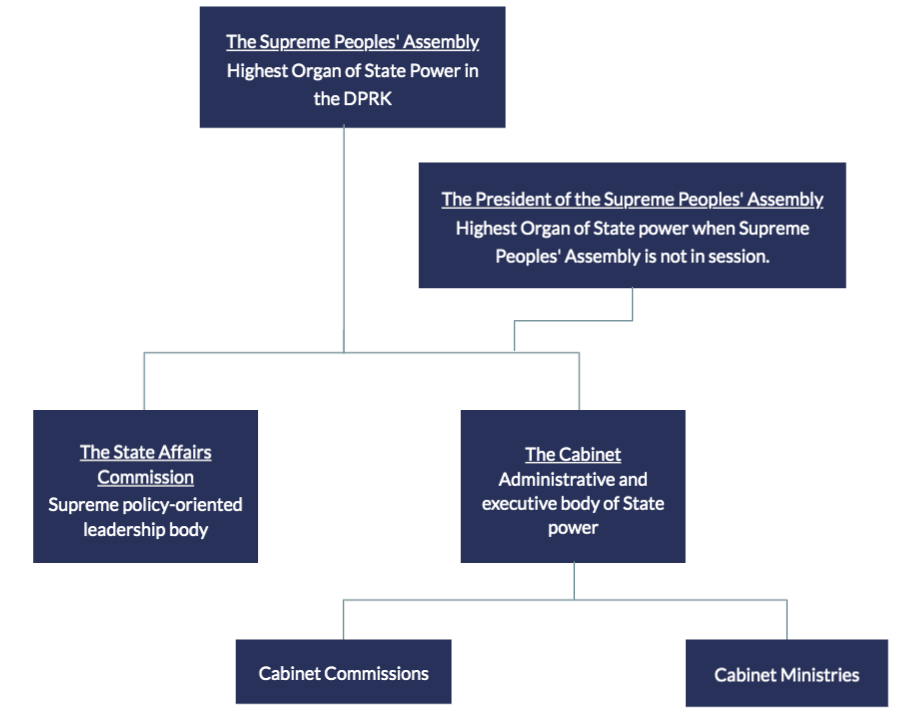
State Organs of the DPRK
The Supreme’s Assembly has the authority to:
- Amend or supplement the Constitution
- Adopt, amend or supplement laws
- Approve the major laws adopted by the Presidium of the Supreme’s Assembly, when the SPA is not in session
- Establish the basic principles of the State Affairs Commission
- Elect or recall the Chairman of the State Affairs Commission
- Elect or recall President of the Presidium of the Supreme People’s Assembly
- Elect or recall the Vice-Chairmen and members of State Affairs Commission on the recommendation of the Chairman of the State Affairs Commission
- Elect or recall the Vice-Presidents, Honorary Vice-President Secretary General and members of the Presidium of the Supreme People’s Assembly
- Elect or recall the Premier of the Cabinet
- Appoint the Vice-Premier, Chairmen, Ministers and other members of the Cabinet on the recommendation of the Premier of the Cabinet
- Appoint or remove the Prosecutor General of the Central Public Prosecutors Office
- Elect or recall the President of the Central Court
- Elect or recall the Chairmen, Vice-Chairmen and members of the Committees of the Supreme People’s Assembly
- Deliberate and approve the State plan for the development of the national economy and the report on its implementation
- Deliberate and approve the State budget and the report on its implementation
- Hear a report on the work of the Cabinet and the central bodies when and adopt the relevant measures
- Hear a report on the work of the Cabinet and the central bodies when necessary and adopt the relevant measures
- Decide on ratification and nullification of treaties suggested to the Supreme People’s Assembly
The Chairman of the State of Affairs Commission of the DPRK
The Chairman of the State Affairs of DPRK is the supreme leader of the DPRK. The term of office is the same of the Supreme People’s Assembly. The Chairman is supreme commander of the whole armed forces of the DRPK and commands and directs all the armed forces of the State.
The Chairman has the following duties and authority to:
- Direct the overall affairs of the State
- Personally guide the work of the State Affairs Commission
- Appoint or remove key cadres of the State
- Ratify or rescind major treaties concluded with other countries
- Exercise the right of granting special pardon
- Proclaim a state of emergency, a state of war and mobilization orders within the country
- Organise and direct the National Defence Committee in wartime
- Issues orders
- Accountable to the Supreme People’s Assembly
State of Affairs Commission
The State of Affairs Commission is the supreme policy-orientated leadership body of the State power and consists of the Chairman, Vice-Chairmen and members. The term is the same as the Supreme People’s Assembly.
The State Affairs Commission has the following duties and authority to:
- Discuss and decide important policies of the State, including those for defence building
- Exercise supervision over the fulfilment of the orders of the Chairman of the State Affairs Commission of DPRK
- Abrogate decisions of directives of State organs which run counter to the orders of the Chairman and the State Affairs Commission
- Issue decisions and directives
- Act accountable to the Supreme People’ s Assembly
Cabinet
The Cabinet is the administrative and executive body of State power and organ of overall State administration. The Cabinet is accountable to the Supreme People’s Court and Presidium of the Supreme Court. The term is the same as the Supreme People’s Assembly. The Commissions and Ministers of the Cabinet are departmental bodies of administration.
The Cabinet has the following duties and authority:
- Adopt measures for the implementation of State policies
- Adopt, amend or supplement the regulations on State administration on the basis of the Constitution and the laws
- Direct the world of the Commissions and Ministries of the Cabinet organs and local People’s Committees
- Establish or abolish organs directly under its authority, major administrative and economic bodies and enterprises and adopt measures for improving State administration bodies
- Draft the State plan for the development of national economy and adopt measures to put it into effect
- Compile the State budget and adopt measures to implement it
- Organise and execute the work of industry, agriculture, construction, transport, post and telecommunications, commerce, foreign, trade, land administration, municipal administration, education, science, culture, health service, physical culture and sport, labour administration, protection of the environment, tourism and so forth
- Adopt measures to strengthen the monetary and banking system
- Inspect and control the establishment of order in State administration
- Adopt measures to maintain publishing order, protect the property and interests of the State and social, cooperative organizations and safeguard the right of citizens
- Conclude treaties with foreign countries and conduct external affairs
- Rescind the decision and directives of administrative and economic bodies which run counter to the Cabinet
- Local State Organs
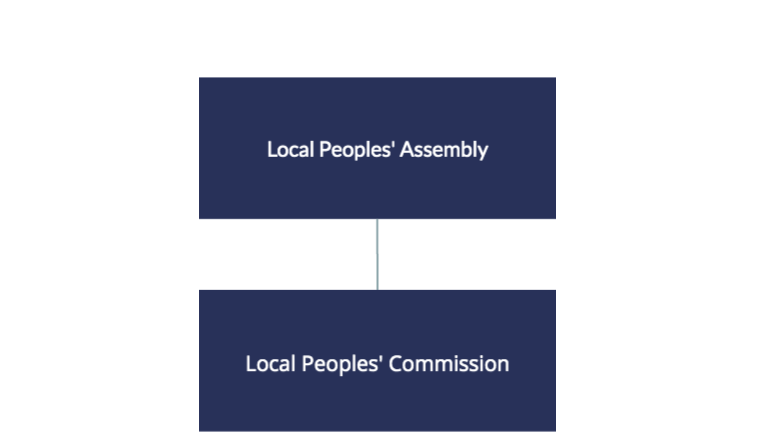
The Local People’s Assembly
The People’s Assembly of a province (or municipality directly under central authority), city (or district) or county is the local organ of State power. The term of office is four years.
The local People’s Assembly has the following duties and authority to:
- Deliberate and approve the local plan for development of the national economy and the report on its implementation
- Deliberate and approve the local budget and the report on its implementation
- Adopt measures to observe State laws in the area concerned
- Elect or recall the Chairman, Vice-Chairman, Secretary General and members of the People’s Committee corresponding level
- Elect or recall the Judges and People’s Assessors of the Court at the corresponding level
- Rescind unwarranted decisions and directives of the People’s Committee at the corresponding level and the People’s Assemblies and People’s Committee at a lower level
The Local People’s Committee
The People’s Committee of a province (municipality directly under central authority), city (or district) or country exercises the function of the local organ of State power when the People’s Assembly at the corresponding level is not in session and the administrative and executive organ of State of the corresponding level. The term of office is the same as the corresponding People’s Assembly; the local People’s Committee is accountable to the corresponding local People’s Assembly.
The local People’s Committee has the following duties and authority to:
- Convene sessions of the People’s Assembly
- Organise the election of deputies to the People’s Assembly
- Work with the deputies to the People’s Assembly
- Implement the decisions and directives of the corresponding local People’s Assembly and the People’s Committees at higher levels, the laws, ordinances and decisions of the Supreme People’s Assembly, the orders of the Chairman of the State Affairs of DPRK, the decisions and directives of the Presidium of the Supreme People’s Assembly and the decisions and directives of the Cabinet and Commissions and Ministries of the Cabinet
- Organise and carry all administrative affairs in the given area
- Draft the local plan for the development of the national economy and adopt measures to implement it
- Compile the local budget and adopt measures its implementation
- Adopt measures to maintain public order, protect the property and interests of the State and social, cooperative organizations and safeguard the rights of citizens in the given area
- Inspect and control the establishment of order in State administration in the given area
- Direct the work of the People’s Committees at the lower levels
- Rescind unwarranted decisions and directives of the People’s Committees at lower levels and suspend the implementation of unwarranted decisions of the People’s Assemblies at lower levels
Judicial and Procuratorial Organs
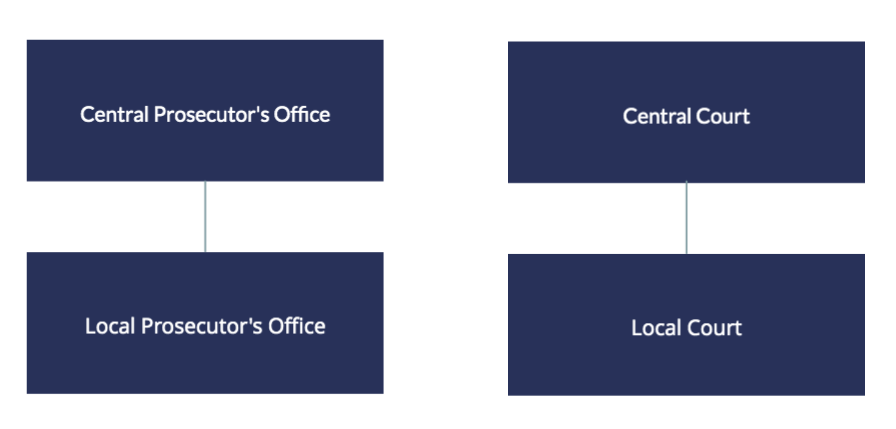
The Public Prosecutors Office and the Court
Investigation and prosecution are conducted by the Central Public Prosecutors Office, the Public Prosecutors Officers of a province (or municipality directly under central authority) city (or district) or county and the Special Public Prosecution Office. The term of office is the same as the Supreme People’ Assembly and public prosecutors are appointed or removed the Central Public Prosecutors. The Central Public Prosecutors is accountable to the Supreme People’s Assembly and to the Presidium of the Supreme People’s Assembly when the Supreme People’s Assembly is not in session.
The functions of the Public Prosecutors Office are to:
- Ensure the strict observance of State laws by institutions, enterprises, organization and citizens
- Ensure the decisions and the directives of State bodies conform with the Constitution, the laws, ordinances and decisions of the Supreme People’s Assembly, the orders of the Chairman of the State Affairs of DPRK, the decisions and directives of the Presidium of the Supreme People’s Assembly and the decisions and directives of the Cabinet
- Identify and institute legal proceedings against criminals and offenders in order to protect the State power of the DPRK, the socialist system, the property of the State and social, cooperative organisations, personal rights as guaranteed by the Constitution and the people’s lives and property
Justice is administrated by the Central Court the Court of a province (or municipality directly under central authority) city (or district) or County People’s Courts and the Special Court. Verdicts are delivered in the name of DPRK. Justice is administrated by a Court consisting of one Judge and two People’s Assessors. In special cases, there may be three Judges.
The functions of the Court are to:
- Protect through judicial procedure the State power and the socialist system established in the DPRK, the property of the State and social, cooperative organizations, personal rights as guaranteed by the Constitution, and the lives and property of citizens
- Ensure that all institutions, enterprises, organizations and citizens abide strictly by State laws and staunchly combat class enemies and all lawbreakers
- Give judgements and findings with regard to property and conduct notarial work
The Central Court is the highest judicial organ of the DPRK and supervises the judicial activities of all the Courts. The Central Court is accountable to the Supreme People’s Assembly and to the Presidium of the Supreme People’s Assembly when the Supreme People’s Assembly is not in session.
Geography of the DPRK
Location
Korea is in the centre of East Asia, where the Asian Continent and the Pacific Ocean meet. The northern border neighbours China and Russia, while the rest of the border is encircled by the east, west and south seas of Korea.
Area
Korea has an area of 223, 935 sq. km. Its northern half is 123, 138 sq. km and southern half 100, 797 sq. km. Korea is also comprised of islets and islands covering a total area of 5,829 sq. km.
Sea Level
On average, Korea is 443 m above sea level. The land above sea-level is found largely in the north and east of Korea, whilst the west and south remain below sea level.
Climate
There are four distinctive seasons in Korea. Winters are usually cold and dry with a cold wind, while summers are hot, rainy and humid.
Landscape
Mountains occupy 79.3% of the land in Korea. The mountain range stretches from Great Paektu mountains in the northern border to Kujae Peak on the south coast. One of the famous mountains in Korea is Mount Paektu, with Lake Chin located on the top and a chain of 200 peaks forming the outer rim.
Plains
Plains occupy 20.7% of Korea. Some plains, such as the Pyongyang plain centred on Pyongyang and Yoltunsamcholli Plain in the west coast, are utilised for crop cultivation.
Rivers
Korea is home to numerous rivers and streams as a result of its valleys and heavy precipitation (annual precipitation of 966.3mm). On average, 0.5 km of river course flows in an area of 1 sq. km. There are 131 rivers and streams measuring over 5 km in length and six major rivers in Korea, including the Amnok, Tuman, Taedong, Kum, Han and Raktong rivers.
Natural Resources
Korea is rich and varied in natural resources. The west, east and south seas of Korea is home to 1,160 species of fish, as well as whales, dolphins, seals and other marine animals. In the west sea of Korea, tidal power can be generated from the conditions of the long tidal ranges, convoluted coasts and numerous islets.
What’s more, there are more than 400 types of minerals located in Korea. Mineral resources range from copper, lead, zinc, gold, silver, as well as metallic minerals such as magnetite, hematite, limonite, copper pyrites, lead glance. Minerals of polymetallic are utilised to produce rare and precious metals to meet the demands of the modern industry.