

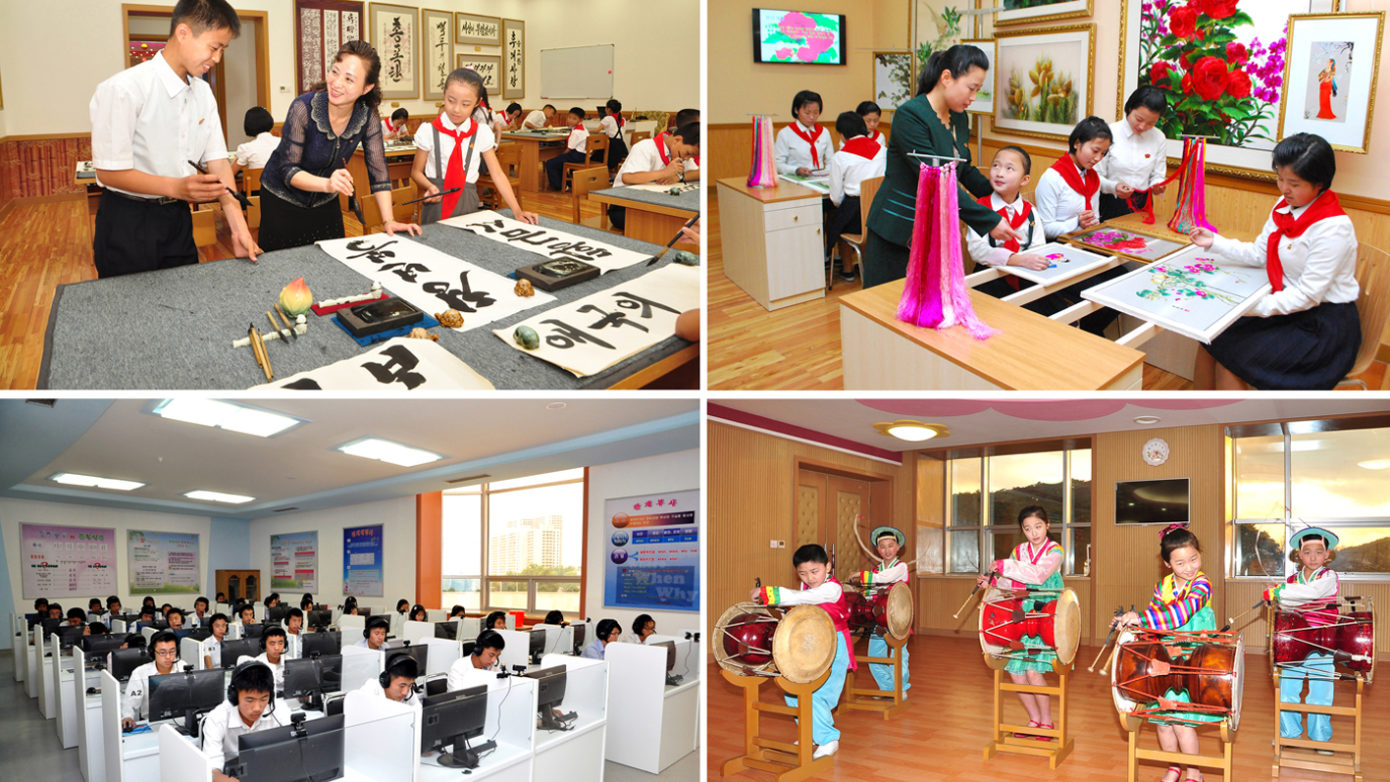

The following is a personal account from a visitor to the Physongsong Art School, located in Phyongsong City.
Some time ago, I visited the Phyongsong Art School situated in Phyongsong City, South Phyongan Province, which is furnished well enough to be considered a model provincial art school.
When I entered the schoolyard through the resting area and studying site lined with tall metasequoias, Song Yong Chol, headmaster of the school, welcomed me, saying, “Now a campaign of giving importance to and supporting the educational work is in full swing across the country. In this atmosphere, we’ve achieved a lot by renovating the educational conditions and living environment of our school.”
According to him, the school has four buildings for instruction that house more than 10 departments for 30 courses and an e-library with some reading rooms and a stack room. The school is also furnished with cultural and welfare facilities—a playground with 400 seats, a dormitory, a dining hall, a bathhouse and a barber shop for pupils.
When I entered Building No. 1, I was very surprised. I found the walls well-built with various finishing materials and covered with different sorts of visual aids to suit the students’ psychology. It seemed as if I were in a museum. Yong Chol said, “Recently we furnished all our buildings like this. Everyone who visits our school says unanimously that it is quite clean, smart and unique.” He then guided me to the administration department.
Ri Tong Chol who works at the administration department said, “In my school, all the classrooms are connected by an intranet, so we can perform a real-time inspection of lectures at work. More than 30 multifunctional classrooms and over 20 modern rooms for practicing special skills have been established, and a comprehensive system for administration of school affairs is in operation. So, the level of education has reached a higher scientific and IT standard.”
Hearing the students’ cheerful singing from the vocal music training room, I looked around the departments of fine arts and public speaking art before calling on students of the dance department. As I was heading for another building, we heard a piece of music which signaled breaktime, also known as “milk time” for the students.
While I was passing the fourth-grade classroom of the primary school course, I saw a pupil tapping the desk drinking a cup of milk. Song told me that that was Ko Jong Song, a piano prodigy of the school. Then we saw her play the piano in the piano practicing room. Indeed, she was an excellent pianist. So Kyong Il, a piano instructor, said, “Every day we give special lessons to promising piano talents like Jong Song and give guidance for their after-school training for more than four hours.” And he added that they would have an artistic skill presentation in the afternoon.
On our way to the hall we met Kim Hyok, chief of the research and instruction guidance department, who said, “According to the school and individual plans, we conduct the work to improve the teachers’ qualifications and assess them at every Thursday meeting of the departments.” He continued that the level of the students’ ability depends on the teachers’ qualifications and ability and that his school was directing a great effort to improve the teachers’ qualifications.
Hearing his words, we went over to the hall where the students were having a skill presentation.
Seeing the students develop their talent to their heart’s content, we felt pleased. Song said, “Many of the school graduates are playing a big role in art troupes like the Moranbong and Chongbong bands, and in their respective communities. In the future, too, we will further improve the educational condition and environment as well as educational methods to train excellent pupils in greater numbers.”
After witnessing the bright future of the school in the students’ cheerful activities, I left highly satisfied with what I had seen.